
Tokyo by Day and by Night: How One City Changes, Plus Common Group Street Kart Mistakes and How to Avoid Them
Tokyo by Day and by Night: How One City Changes, Plus Common Group Street Kart Mistakes and How to Avoid Them
Walk through the Shibuya crossing during the day, then come back and walk through it again at night. It's the same spot, but it feels like a different city! Tokyo has plenty of places like this. So if you're going to ride a street kart with friends, learn how day and night differ before you book. If you don't, it's easy to miss the views you came for, end up with someone shivering from the cold, or waste time trying to meet up. This article goes through each store's route and shows how Tokyo's streets change from day to night. After that, it covers the mistakes groups tend to make and how to avoid them. Let's plan this together.
Daytime Tokyo and Nighttime Tokyo Show You Completely Different Things
Put simply, during the day you notice the details, and at night the lights take over.
In the daytime, the materials and colors of the buildings are right there in front of you. The texture of red-brick walls. The colors of clothes in shop windows. Leaves on the street trees moving in the breeze. You can read every word on the signs, so you naturally start to understand what kind of neighborhood you're in.
At night, most of that disappears. What stands out instead are lit-up bridges and towers, office windows glowing, and neon filling the intersections. The outlines get blurry, but the amount of light tells you how much energy the city has.
Take a moment here and picture the city from the seat of a kart.
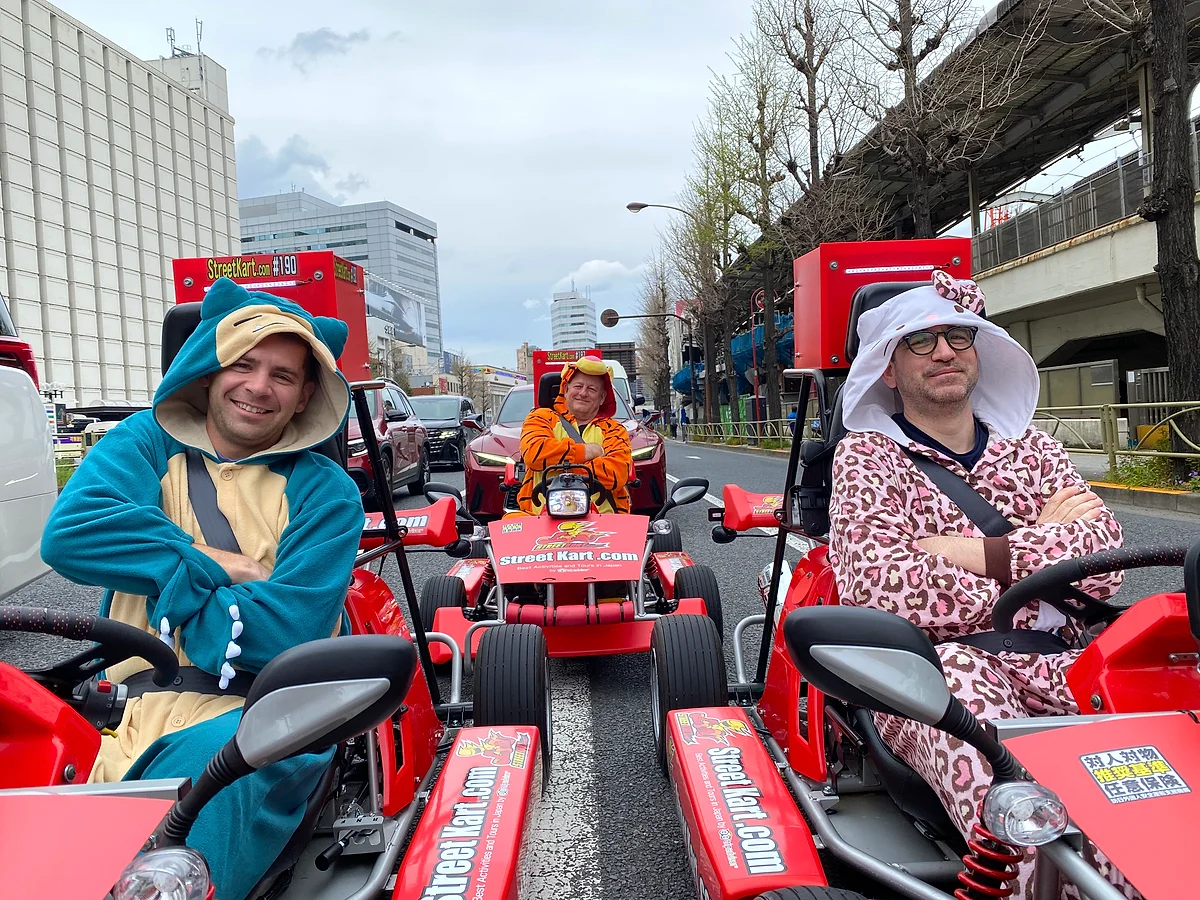
It's not like walking on the sidewalk, and it's not like looking out a bus window. You're holding the steering wheel yourself and driving right through the middle of the city. Look up and the buildings tower over you. Once you're moving, the wind and the noise of the streets hit you directly. During the day, you'll be looking up at one building detail after another from that low seat. At night, it feels like light is pouring down on you from above. The route may be the same, but what you take away from it is completely different.
This is where the first trap comes in: picking a time slot before your group has agreed on what it wants to see. One person falls for a night-view photo online and picks the night tour, and then on the day someone else quietly says, "I wanted to see the streets in daylight." That can easily happen. Neither one is wrong. Just decide what you want to see first, and then book. Don't do it the other way around.
The easiest way to decide is to have each member name the one view they most want to see. The red-brick station building, the zelkova-lined avenue, the lit-up bridge, the neon at the crossing. Once they're all listed, it's clear which views look best by day and which look best by night. Pick the time slot that gets the most votes and save the other one for next time. If you lay out everyone's wishes at the start like this, it's less likely that someone will feel left out on the day.
Day and Night Tokyo, Store by Store
There are seven stores in Tokyo. However, Akihabara Store 1 and Store 2 are almost in the same place, and so are the Shibuya store and Shibuya ANNEX. So even though there are seven stores, if you're choosing by scenery, it's easiest to compare the Bay Area, Akihabara, Shibuya, and Shinagawa. Each store has a set course, so you can't just drive wherever you want. Below are examples of the views on each route.
On the Tokyo Bay store (Shinkiba) route, the star is the Rainbow Bridge over Tokyo Bay! It's a 798 m suspension bridge, and at night it's lit up in seven colors. In the daytime the views are wide open: blue sky and sea, with warehouse districts next to modern buildings. If you book an evening slot you can enjoy the night view too, and the bridge lights and the glow of the 333 m Tokyo Tower take over the show. The route runs along the water, so picture the sea breeze as well. Around Odaiba, where large shopping complexes line the area, the shapes of the buildings stand out clearly in daylight, so you can take your time looking at a skyline that feels like a city of the future.
On the Akihabara Store 1 and Store 2 routes, the signature spots are the Marunouchi building of Tokyo Station, Ginza, and Akihabara Electric Town. In the daytime, look at the solid red-brick exterior of the station building, which opened in 1914, and the Wako clock tower at the Ginza 4-chome intersection. These buildings look their best when you can see the details. Akihabara Electric Town, on the other hand, changes once the sun goes down, as the glowing signs become much more noticeable.
On the Shibuya store and Shibuya ANNEX routes, the signature spots are the Shibuya Scramble Crossing, Harajuku's Takeshita Street, and Omotesando. The zelkova trees along Omotesando and the colorful shopfronts of Takeshita Street show off their colors in daylight. Omotesando is also lined with distinctive buildings designed by architects, so during the day you can compare how different each one looks. At the Scramble Crossing, night neon and the flow of people create a scene you won't forget.
On the Shinagawa store route, you'll see the high-rises around Shinagawa Station, with the Rainbow Bridge and Tokyo Tower in the distance. In the Shibaura and Tamachi bay area, daytime brings office districts and waterfront views, while nighttime brings lit office windows and lights on the water. The Takanawa area has historic temples, including Sengakuji, where the graves of the Ako Roshi (the 47 Ronin) are, as well as embassies. In the daytime you'll find calm streets that feel very different from the business district. The Shinagawa store also offers evening courses when there is less traffic.
Whether day or night slots are available, and which stores offer them, depends on the store and the plan. If night views are what you're after, check the official website first, then work out the dates with your group.
6 Common Group Mistakes and How to Avoid Them
Mistake #1: Underestimating how cold it feels at night. If you ride at night in the same clothes that were fine during the day, the wind after sunset can feel colder than you expected. When you're driving, it hits you directly. And in a group, people often feel awkward saying "I'm the only one who's cold." While one person puts up with it, the fun slowly drains away for everyone. Bring an extra layer that suits the season. Raincoats are provided for light to moderate rain. Check the official website in advance for detailed dress rules and how weather is handled.
Another common mistake on night tours is dressing up for dinner afterward. Open-toed shoes, heels, skirts, dresses, and expensive clothes are on the list of things to avoid. Wear closed-toe sneakers and clothes you can move in for the ride, and if you want to change afterward, pack your things into a small bag. The stores have lockers for small items, but they aren't suitable for large luggage like suitcases. For daytime tours, especially in summer, a hat, sunglasses, and sunscreen will come in handy.
Mistake #2: Drinking with a meal before a night booking. When you plan an evening, it's tempting to pair it with dinner. We get it. But if you drink, you can't drive. Save the toast for after the tour! If the whole group knows the order ahead of time, you can avoid the sad situation where one person can't join on the day.
Mistake #3: Trying to take photos or videos while driving. The night lights are beautiful, and it's tempting to point your phone at them. But while you're driving, your focus belongs on the steering wheel and the road ahead. Follow your guide's instructions on photography on the day. The tour includes stops at photo spots. If you want other photos, take them on foot before or after the tour. Night shots blur easily, so lean against a guardrail or pillar, switch on your phone's night mode, and hold still for a few seconds. That alone makes a big difference. It's the same idea as basic outdoor photography: use your body as a tripod.
Mistake #4: Heading to the store by car or taxi at the last minute. The stores have no parking. Use public transportation. You'll also have check-in and a safety briefing, so you need to arrive at least 15 minutes early. Roughly: the Tokyo Bay store is an 8-minute walk from Shin-Kiba Station, Akihabara Store 1 is a 5-minute walk from Akihabara Station, the Shibuya store and Shibuya ANNEX are a 5-minute walk from Shinsen Station (10 minutes from Shibuya Station), and the Shinagawa store is a 3-minute walk from Kita-Shinagawa Station.
Mistake #5: Meeting up in front of the store. To avoid missing each other, meet at the ticket gates of the nearest station instead. This matters especially at night, when landmarks you saw during the day are hard to spot in the dark. Make the meeting point the station gates rather than the store, and walk there together. To set the meeting time at the gates, start from when you need to be at the store (15 minutes early), subtract the walk from the station, and then add a little extra. That way nobody has to panic if someone gets held up changing trains. If a member might be late, it also helps to have a way to pass messages around the group quickly.
Mistake #6: Not having each person check their own driver's license. This is the most painful one on a group trip. Everyone shows up, and only on the day do you find out that one person's license doesn't let them drive. The karts are single-seaters, so they can't ride along next to someone else. And if you don't have the required documents on the day, you can't take part and you won't get a refund. You need your original physical license; digital licenses are not accepted. The required license types and what to bring are listed on the driver's license page. Before booking, every member should check it with their own eyes. The organizer shouldn't just assume "it'll probably be fine." See the official website for details.
How to Plan Around Everyone's Schedule
The bigger the group, the more people differ on where they want to go, when they get up, and how much energy they have. So the easiest approach is to lock in one kart slot first, then plan everything else around it. Put the hard-to-move plans down first, and add the flexible ones later.
First, decide as a group whether you want to see the streets by day or the lights by night. Once that's settled, you can narrow down which stores to consider. Next, choose one person to be the contact. Have everyone report their license check and whether they can join to that person. Bookings are accepted through Facebook, LINE, or email (booking@streetkart.com). It's best to have just one person dealing with the store.
Weekends fill up fast, so if you're going on a weekend, act early. Cancellations are free up to 7 days in advance. Confirm who is going ahead of time, and if you need to cancel or make other changes, get in touch before the free cancellation deadline.
A single group can have up to 6 drivers plus 1 guide as standard. Only the Tokyo Bay store can take larger groups, which then ride as several separate groups. If you have a lot of people, ask about it when you book.
Tour guidance on the day is mainly in English. If some members aren't comfortable with English, it can help to have them read the explanations on the website beforehand. The website is available in 22 languages. If you have any concerns about language, contact the store in advance through the official website.
It's fine to split up before and after the ride based on energy levels and interests. At the Shibuya store, you can look down over the city from the observation deck at Shibuya Scramble Square, about a 10-minute walk from the store, before heading over. At the Shinagawa store, you can stop by Shinagawa Shrine, a 5-minute walk away, before riding, or after the ride you can walk about 20 minutes to Tennozu Isle and stroll along the canals. At the Akihabara stores, Kanda Myojin shrine, about a 10-minute walk away, is worth a visit. None of these places are on the tour course; they're places to visit on your own before or after the ride. Odaiba near the Tokyo Bay store is an area the tour passes through, and since it's only about 10 minutes from the store by car, going back to explore it on foot after your ride turns it into a full day in the Bay Area. When you walk around the city at night, take your trash home with you. Even when you're having a great time with friends, don't forget to respect the city.
Why Street Kart
At Street Kart, a trained guide leads the way. This isn't a ride where you squint at a map app trying to find the way.
As of November 2023, Street Kart had run more than 150,000 tours, served more than 1.34 million customers, and collected more than 20,000 reviews with an average rating of 4.9/5.0. For groups with first-time riders, those numbers give a good sense of what to expect.
Once You've Picked Day or Night, Pick a Date
Daytime Tokyo is when you get a feel for how the city is built. Nighttime Tokyo is when you drive through the lights. Neither one is the right answer. Have your group decide "this time we're doing this one!" and then pick the store, clothes, and meeting spot to match. That alone will cut down a lot of mistakes on the day.
Start by having every member check the driver's license page, then see on the official website whether there are slots at the time you want. Weekends fill up fast, so once your dates take shape, get in touch early through Facebook, LINE, or email.
Red brick you looked up at in daylight. Bridge lights that washed over you at night. The Tokyo you drive through with friends is sure to look completely different by day and by night. Once you've seen both, your Tokyo won't be the guidebook version anymore. So, which one will you do first?
This article was originally written in Japanese and translated using AI. Some expressions may read unnaturally, and we appreciate your understanding. For the most accurate and up-to-date information, please refer to the official site at kart.st.
Street Kart is not affiliated with Nintendo or the Mario Kart series in any way. We do not provide costumes of Nintendo characters, and such costumes may not be worn during tours even if brought by participants.