
How to Pick Dates for a Group Trip to Tokyo: Planning Your Street Kart Tour Around Your Companions' Preferences
How to Pick Dates for a Group Trip to Tokyo: Planning Your Street Kart Tour Around Your Companions' Preferences
"So, when are we going?"
You post that in the group chat, and the "seen" count goes up, but nobody answers. Most of us have been there. Once you try to find a day that works for everyone, the conversation stalls.
So try asking in a different order! Before you talk dates, find out how your friends feel about heat, cold, crowds and scenery. Who hates what, and what gets them excited? Once you know that, the possible travel seasons narrow down on their own. This article shows how to pick the timing for a Street Kart tour in Tokyo by starting from what your companions like and dislike.
Ask "Who Cares About What?" Before "When Are We Going?"
The bigger the group, the harder scheduling gets. The reason is simple: there just aren't many days when everyone is free. And the one day you finally find may turn out to be "way too hot!" for someone in the group.
To be honest, group scheduling usually goes wrong because of how people handle the weather, more than because of their calendars. Pick midsummer when a friend can't handle heat, and they'll be the one wilting on the day. If someone hates the cold, check with them before you plan a winter ride along Tokyo Bay.
So change your first question from "When are you free?" to "Which is worse for you, hot or cold?" Then ask, "Are you okay with crowded places?" and "Is there any scenery you want to photograph?" Those few questions narrow down the seasons a lot. You can open the calendar after that!
Surfing works the same way. Whether the waves are good on a given day depends on the skill level and condition of the friends paddling out with you. Maps and forecasts alone won't tell you the best day. It depends on who you're going with.
How Your Companions' Reactions Shift with the Seasons
Everyone Handles Heat, Cold and Rain Differently
Tokyo summers are hot and humid, and the daytime heat slowly drains your energy. It's easy to assume that people from hot countries will be fine, but that isn't always true. People used to dry heat may be the most caught off guard by Tokyo's humidity. If you go in summer, build in extra time to rest in air-conditioned cafés before and after the tour, and agree as a group on how you'll stay hydrated. That alone will make the day much easier.
Winter brings clear air and sharp views. But once you're out in the wind, it feels a lot colder. If anyone in the group doesn't like the cold, remind everyone to bring layers. Small items like gloves and neck warmers will make a big difference.
Spring and autumn have more comfortable days. Still, pollen in spring can be hard on some people's eyes and noses, and autumn is typhoon season. In rainy periods, including the rainy season around June, go in assuming plans may change. That way, tension in the group is less likely to build. How tours are handled in bad weather depends on the season and the situation, so check the official website for details.
By the way, December is the height of summer in Australia, but it's winter in Japan! If a Mate is coming from the Southern Hemisphere, just let them know that "Tokyo gets pretty cold in December." That one comment makes a real difference when they pack.
Scenery Lovers vs. Atmosphere Lovers
In any group, some people get excited about views and others react to the buzz of the city. Which type you have more of affects both which store you pick and how you think about timing.
Tours from the Tokyo Bay store take a route with views of the Rainbow Bridge and Tokyo Tower. The 798-meter Rainbow Bridge is lit up in seven colors at night. If your group loves night views, check whether there's a time slot that lets you drive after dark. Sunset times vary a lot by season, though, so check the official website before booking, including the departure slots.
Tours from the Shibuya store and Shibuya ANNEX pass through the Scramble Crossing, Omotesando and the Harajuku area. The zelkova trees along Omotesando are also known as a spot for photographing illuminations in winter. If most of your group loves crowds and city energy, this area will probably suit you.
Tours from the Akihabara stores pass the red-brick Marunouchi building of Tokyo Station and the streets of Ginza. The historic station building opened in 1914, and you'll want to photograph it in any season. If anyone in your group loves anime or subculture, plan the whole day so it includes time to explore Akihabara before or after the tour.
Lining Up Everyone's Schedules: Change the Order You Decide Things
Once you've narrowed down the season, it's time to pick a date. Again, a small change in the order you decide things keeps the conversation moving.
First, settle the fixed commitments, the days that can't move: flights, other activities already booked, someone's work schedule. Once everyone writes theirs down, you can clearly see which days are off limits. Next, narrow the gaps down to two or three possible dates. If you try to lock in a single day right away, someone usually ends up compromising. Having several options leaves room to adjust.
One thing you should know: weekends tend to book up quickly. If everyone in the group can only go on a weekend, book soon after you settle on your dates. On the other hand, if most of you are traveling and free on weekdays, consider planning around weekdays instead.
Another key point is to put one person in charge of deciding. When everyone discusses at once, time passes and nothing gets decided. Once you've collected everyone's preferred dates and stores, the organizer becomes the point of contact for the booking. Everyone else just goes along with whatever is decided. This works surprisingly well.
Bookings are accepted via Facebook, LINE and email (booking@streetkart.com). On the tour, a guide leads you along a set course. For large groups, contact them early to ask about capacity. That makes the rest of the planning easier.
Check Licenses and Language Early, Person by Person
What group trips often miss is each member's own preparation. Street Kart drives on public roads, so every participant has to meet the driver's license requirements. What you need depends on your country and license type, so each person should check the official driver's license page several weeks before departure. If one person can't drive on the day, it brings down the whole group. The day is best when everyone makes it to the starting line together!
Share the language details in advance, too. Guidance on tour day is generally in English. Guidance in Japanese or other languages depends on the staff that day and can't be guaranteed. If anyone in your group isn't comfortable with English, ask through the official website in advance. The website is available in 22 languages. Post the link in the group chat with a quick "please read this, everyone." That's the least bit of preparation worth doing.
Street Kart from a Group's Point of View
When you choose an activity for a big group, the main question is whether everyone will enjoy it equally. Seen that way, Street Kart has several things going for it.
First, a trained guide leads the way. You simply follow the guide in front, so nobody has to stare at a map on their phone and take on the job of navigating.
Next, each store has set courses. You don't pick your own roads, so all the group has to decide is the store and the course. The bigger the group, the more you'll appreciate having fewer decisions to make.
And then there's driving the kart itself.
Let me take a moment here.
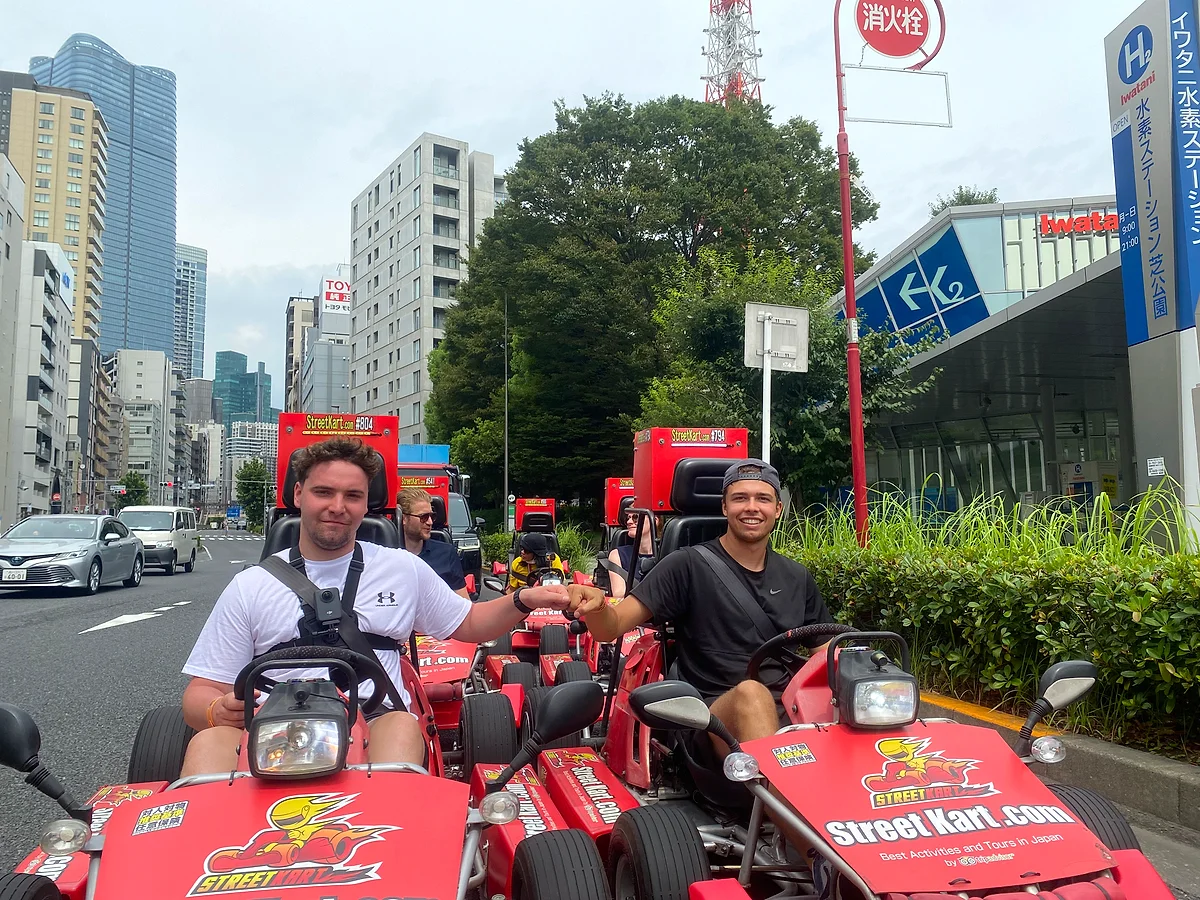
Once you grip the wheel and pull away, the ground feels like it's right there under you. The wind hits your face and the sounds of the city come straight to your ears. Buildings and bridges you usually only look up at come at you fast from angles you've never seen. It might feel like watching the horizon from just above the water while you wait for a wave. This is a Tokyo you feel with your whole body, not one you watch through a window. And you get to experience it at the same moment as the friends beside you.
Having a choice of stores helps too. Of the 9 stores nationwide, 7 are in Tokyo. Note, though, that Akihabara Store 1 and Store 2 are in almost the same location, and so are the Shibuya store and Shibuya ANNEX. Do you want to see the bay views or the downtown streets? Choose based on what your group prefers.
As for track record, as of November 2023, Street Kart had more than 20,000 total reviews with an average rating of 4.9/5.0. That may help when you talk with group members who are cautious about trying something new.
Finally, it's easy to combine the tour with sightseeing before and after. There are plenty of places to visit around each store, so the tour fits easily into your group's day. The next section covers this in more detail.
Use the Time Before and After as Buffer for Meeting Up
With a big group, just getting everyone to the same place at the same time takes work. People stay at different hotels, earlier plans run late. It happens all the time. That's why you should build in buffer time before and after the tour for gathering and splitting up. That alone makes the day go much more smoothly.
The Shibuya store and Shibuya ANNEX are about a 5-minute walk from Shinsen Station and about 10 minutes from Shibuya Station. You could stroll around Meiji Jingu (a 20-minute walk from the store) before the tour and head to the store from there, or have a meal in Shibuya afterward and part ways there.
The Tokyo Bay store is about an 8-minute walk from Shin-Kiba Station, and Toyosu Market and Odaiba are about 10 minutes away by car. After the tour, head to Odaiba and take some time to relax and talk while enjoying the view. Swap the photos you just took, and someone might say, "I want to do that again!"
The Shinagawa store is about a 3-minute walk from Kita-Shinagawa Station, and Shinagawa Shrine is a 5-minute walk away. It works well as a meeting spot before the tour. Afterward, you can walk about 20 minutes to Tennoz Isle and stroll along the canals.
Around the Akihabara stores, Kanda Myojin shrine and the Electric Town are about a 10-minute walk away, so you won't get bored if you have some time to wait.
The stores have no parking, so plan to use public transportation. If your group is traveling by train, don't leave all the transfers to one person. Make sure everyone can check the route on their own phone. That way, if anyone gets separated, it's easy to meet back up.
Letting the season decide what you do after the tour makes things easier too. In summer, cool off somewhere air-conditioned; in winter, go get something warm to eat. Watch how your companions are doing that day and go at your own pace without pushing it.
Once the Dates Are Set, Here's What to Do Next
If you get stuck choosing a season, go back to "who cares about what." The person who can't handle heat, the one who wants night views, the one who just loves a lively city. Put everyone's preferences together, and you'll find a season and store the whole group is happy with.
Once your dates are set, everyone checks their license requirements, and the organizer handles the booking. If you're aiming for a weekend, book early. You can check each store's courses and the latest information on the Street Kart official website. For large groups or any questions, reach out early via Facebook, LINE or email.
One last thing.
It's one kart per person, and you're the only one at the wheel. But your friends are in front of you and behind you, feeling the same wind and turning at the same intersections. That time driving side by side will probably come up again and again later.
So make the "So, when are we going?" conversation part of the trip too. That group chat full of "seen" receipts will probably get a bit livelier!
This article was originally written in Japanese and translated using AI. Some expressions may read unnaturally, and we appreciate your understanding. For the most accurate and up-to-date information, please refer to the official site at kart.st.
Street Kart is not affiliated with Nintendo or the Mario Kart series in any way. We do not provide costumes of Nintendo characters, and such costumes may not be worn during tours even if brought by participants.