Street Karting in Tokyo with Friends Who Don't Share Your Language: Should You Ride in Daylight or After Dark?
Street Karting in Tokyo with Friends Who Don't Share Your Language: Should You Ride in Daylight or After Dark?
Five of you have come to Tokyo together, and one of you isn't very confident in English.
Lots of trips look like this! For sightseeing, a translation app on your phone usually gets you through. Street karting is a bit different. On the day of the tour, guidance is basically given in English. Whether you get guidance in Japanese or any other language depends on the staff working that day, so it can't be promised.
So do you leave that one friend behind?
No. Everyone rides!
To make that work, the big question is when you ride. On the same route, riding in daylight and riding after dark change how much you have to rely on language quite a lot. In this article, let's work through how to think about time of day when you're riding through Tokyo with a friend who has trouble following the language.
Why Does the Language Barrier Feel Heavier or Lighter Depending on the Time of Day?
Let's start with how the tour works.
On every tour, a trained guide leads the way and participants drive behind them. Each course has a fixed route, so you never pick your own roads. That means your job while driving is to watch the kart in front of you and the guide closely, and follow.
This is the key point.
Even if you can't catch every word of the English explanation, having plenty of visual cues makes you feel more at ease. The guide's movements up ahead. The brake lights of the kart in front. The flow of the lane. How clearly you can see all of this depends on how bright it is around you.
The other factor is fatigue.
Spending a whole day in a language that isn't your own wears your brain down more than you'd expect. You go sightseeing from the morning, get lost changing trains, and order at a restaurant by pointing at the menu. By evening, your friend has that look on their face that says, "I can't take in any more English or Japanese." Haven't you seen that look on a travel companion before?
To be honest, you can't settle the time-of-day question just by looking at a clock. In Tokyo, day length changes a lot with the seasons. In summer it stays light until late in the evening, and in winter it gets dark surprisingly early. You can book the same time slot and find it still bright in summer and pitch dark in winter.
So in this article, instead of asking what time to ride, we'll ask whether it's light or dark, and whether your friends' heads are still fresh.
Daylight: More Information Comes Through Your Eyes
If you're with a friend who faces a language barrier, the first option to consider is a daylight ride.
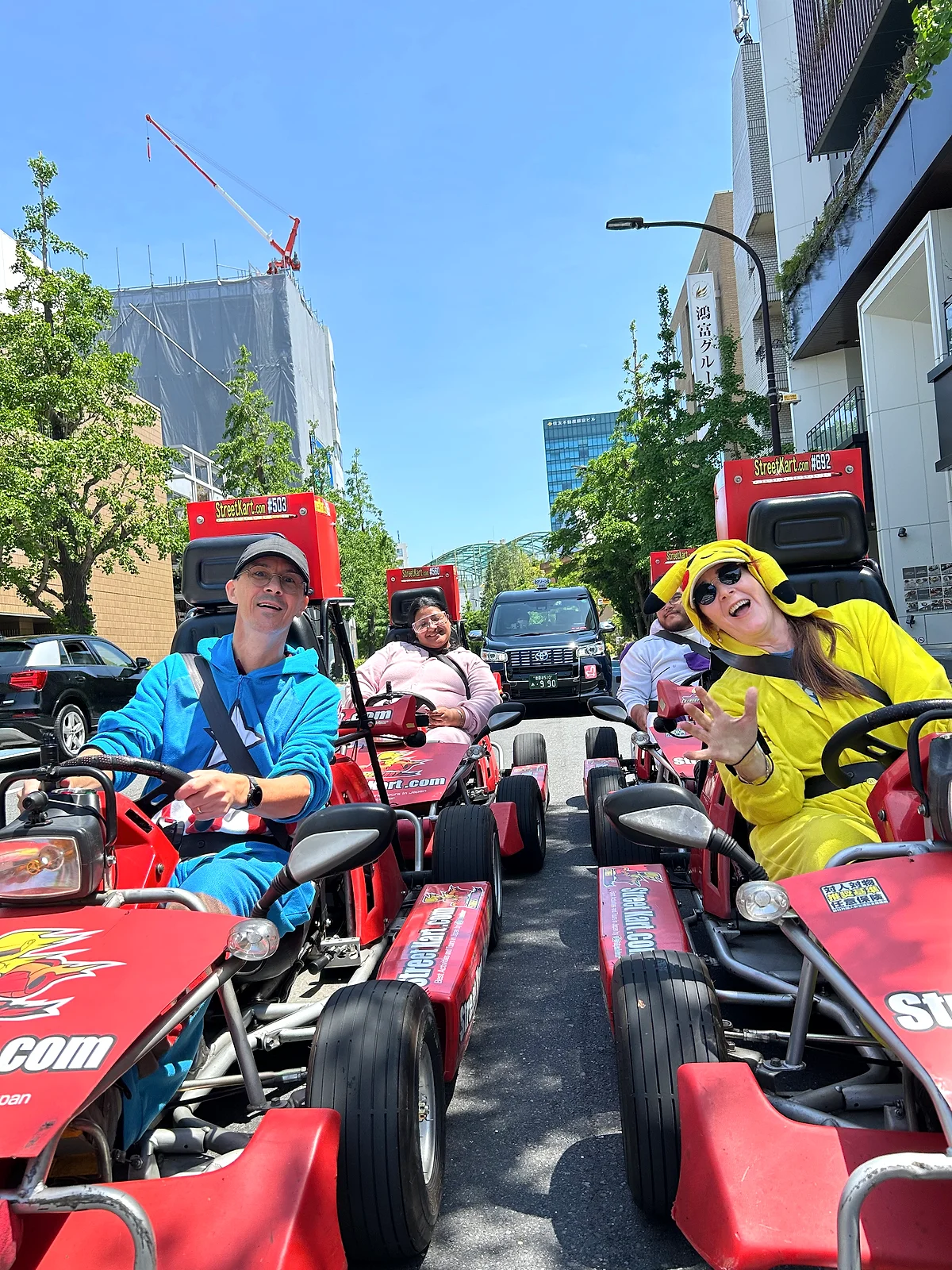
In daylight you can clearly see what the guide ahead is doing. It's easier to judge the gap to the kart in front. The shape of intersections and the position of traffic lights come into view naturally as you drive. Even if your friend only catches half of the English instructions, they can think, "I just need to do what the person in front is doing." That sense of reassurance changes how tightly they grip the steering wheel.
The scenery has its own daytime charm, too.
On a course leaving from the Shibuya store, you can see Shibuya Scramble Crossing and the zelkova-lined avenue of Omotesando in full daylight. The green of the trees and the outlines of distinctive buildings by well-known architects both look crisp and sharp while the sun is out.
On a course from the Akihabara store, the wall of signs in Akihabara Electric Town and the red-brick station building of Tokyo Station stand out in the daytime light. Many of these buildings you'll recognize the moment you see them, no explanation needed. That's what makes the daytime route fun.
Let me pause here for a moment.
Take the Marunouchi Station Building at Tokyo Station. It's a red-brick building that opened in 1914 and finished its restoration in 2012. When you come around to the front, a brick facade stretches out to the sides for a long way. In the sunlight, you can see that bricks that looked plain red actually have slightly different shades mixed in. You drive past a building more than 100 years old, looking up at it from the low seat of a kart. Red brick really does look best in good light.
The tour includes stops at photo spots. During these short breaks while the karts are parked, the friend who's good at English can give a quick recap of what the guide has said so far. Just don't get so caught up in talking that you miss the signal to move off. A sentence or two is plenty.
It's also easy to plan things before and after the ride. Near the Shibuya store, Meiji Jingu is about a 20-minute walk away. Walking through its large forest, everyone can share the same time without needing to talk. For a friend who struggles with English, getting to relax a little here can make a big difference. If you're riding from the Shinagawa store, stopping at Shinagawa Shrine, a 5-minute walk away, before meeting up also works well.
That said, daylight isn't always the easy option!
Tokyo gets very hot during summer days. The kart has no roof, so you're in direct sunlight. When heat wears down your concentration, the physical challenge can end up bigger than the language one. In summer, don't pack too much into your schedule beforehand. Drink plenty of water and show up rested.
After Dark: More Lights, Fewer Cues
On the other hand, I completely understand wanting to drive through Tokyo at night!
The course from the Tokyo Bay store includes the Rainbow Bridge.
Let's take a careful look at this one too. It's a suspension bridge 798 m long. At night it's lit up in seven colors, so it looks like a rainbow stretched over Tokyo Bay. Beyond it, the 333 m Tokyo Tower stands glowing with lights. You drive through all that light yourself, with the sea breeze from the bay on your face. That's a moment that will probably stay with you long after the trip.
What you need to think about here is that after dark, the kinds of visual cues you can pick up change.
There's more light from the city. But the small movements of the guide and the kart in front aren't as clear as they are in daylight. For a friend who has trouble following English instructions, there's a bit less room to work things out by watching.
That's why, if you choose to ride after dark, agree on one rule within your group beforehand: "If you get confused, don't stop or turn on your own. Follow the kart in front and the guide." The basic rules while driving are to follow the guide's instructions and keep a safe distance. Tell your friend this one rule in their native language before you set off.
Next, back to fatigue.
If you choose a night tour, keep your plans light that day. This is a must! If you cram in sightseeing from the morning and head to the night tour exhausted, it'll be hardest on the friend facing the language barrier. It's the same in the mountains or at sea: if you leave the hardest thing for late in the day, your judgment gets dull. Make the night tour the one main event of the day. That's about the right mindset.
For planning a night ride, I suggest having a light meal a little early before meeting up. At that meal, the member who's good at English can explain the day's plan in your friend's native language.
A word on the seasons, too. On summer nights the daytime heat eases off, so it can actually be easier on your body. In winter, on the other hand, it gets dark early and the wind is cold. The bay area is especially windy. Wearing layers will help.
How to Coordinate the Group's Schedule
With a larger group, the hardest part is lining up everyone's schedules. Here's a way to think through the planning. Whether a larger group can join depends on the date and the store, so tell them how many people you have when you book and confirm.
Plan Around the Person Who Will Find It Hardest
When choosing a time slot for the group, it's tempting to go with whatever the most enthusiastic person wants.
But if you have a friend facing a language barrier, plan around their energy and focus. Is it the day after arrival, with jet lag still hanging on, or later in the trip? Are they a morning person or a night owl? Put the tour at the time they'll be at their best. Do that, and the whole group starts to run smoothly.
Next, decide what to do before and after the tour.
If you rush in right at the meeting time, you can't listen calmly to the pre-ride briefing. For a friend who isn't comfortable in English, having to hurry through that first briefing is stressful. The briefing covers how to operate the kart, the route, and safety points. If you share ahead of time within your group what kind of information will come up, it's easier to know what to listen for. The stores have no parking, so plan to travel by public transport and arrive with time to spare. The Shibuya store is about a 5-minute walk from Shinsen Station, and Akihabara Store 1 is about a 3-minute walk from Suehirocho Station.
After the tour, whether you rode in daylight or after dark, set aside some time to look back on the day in your own languages. When someone asks, "What did the guide say back at that intersection?", the friend who's good at English can act as interpreter and pass along what the guide said. Around the Tokyo Bay store, you can follow up with a meal in Odaiba. Having this kind of time helps the friend facing the language barrier feel like they really took part.
Book Weekends Early
Weekends fill up quickly, so booking early is recommended.
When traveling as a group, the days that work for everyone tend to be weekends. Once your dates are set, having two preferred time slots ready makes things go smoothly. For example, make the time when your friend facing the language barrier has the most energy your first choice.
If you have questions about how the tour group will be arranged, or want to let them know about a member's situation, it's a good idea to ask when you book. See the official website for details.
What Makes Street Kart Work When You Ride with Friends Who Speak Different Languages
Here's one thing worth noticing when you ride with friends who speak different languages.
It's the experience of the vehicle itself. There's no roof, and you sit low. The sounds and wind of the city reach you directly. The buildings seem to loom right over your head. This is an experience that doesn't need words. Whether you're good at English or not, everyone feels the same wind from the same height.
What to Do as a Group Before Booking
Finally, here's a summary of how to prepare before you go.
First, check driver's licenses. You need a valid driver's license to take part, and the requirements differ by country and license type. Check for every member early. For details, see the driver's license information on the official website. If even one person in your group doesn't meet the requirements, your plans for the day can fall apart.
Clothing is something to remind each other about as a group too. Choose closed-toe shoes like sneakers, and avoid sandals, heels, skirts, and dresses. The stores have lockers for small items, but they aren't suited to large luggage like suitcases. If you're fitting the tour into a travel day, check the official website in advance about what to do with large bags.
Next, brief your friend who faces the language barrier ahead of time. If the website is available in their native language, check beforehand how much of it they can read. Checking a translation on your phone while driving is dangerous, so make sure they understand everything before setting off. This is a must.
If you're worried about language, get in touch before booking. Reservations and inquiries are accepted via Facebook, LINE, and email (booking@streetkart.com). Let them know your group size and that one of your members isn't comfortable in English.
Ride while it's light, or after dark?
The answer is different for every group.
But if you plan around the time when your friend facing the language barrier has the most energy, you won't go far wrong. Tour details and available time slots vary by store and by day, so start by checking the Street Kart official website in languages that suit every member, and then decide on a time with your friends.
The red brick you look up at in daylight and the seven-colored bridge over the bay at night are both Tokyo. Whichever you choose, let's make it a trip where, when you look back after the finish, everyone is still there with you!
This article was originally written in Japanese and translated using AI. Some expressions may read unnaturally, and we appreciate your understanding. For the most accurate and up-to-date information, please refer to the official site at kart.st.
Street Kart is not affiliated with Nintendo or the Mario Kart series in any way. We do not provide costumes of Nintendo characters, and such costumes may not be worn during tours even if brought by participants.