
Driving Shibuya, Tokyo a Second Time: How to Find the City's Many Faces and How to Line Up Your Group's Schedules
Driving Shibuya, Tokyo a Second Time: How to Find the City's Many Faces and How to Line Up Your Group's Schedules
The light turns green. People start walking all at once, from every direction.
On my first street kart ride through Shibuya, that scene was all I could think about too. And that's fine! But Shibuya has more going on than that one crossing. The second time around, let's go looking for the angle of the slopes, the smell of the tree-lined avenues, even where the shadows of the buildings fall. In the second half, I've also put together a plan for lining up everyone's schedules when you go with a big group of friends.
The First Time, the Scramble Crossing Takes Up All Your Attention
Up to 3,000 people are said to cross the Shibuya Scramble Crossing at once. You drive your kart right past that wave of people. No wonder first-timers remember only the crossing.
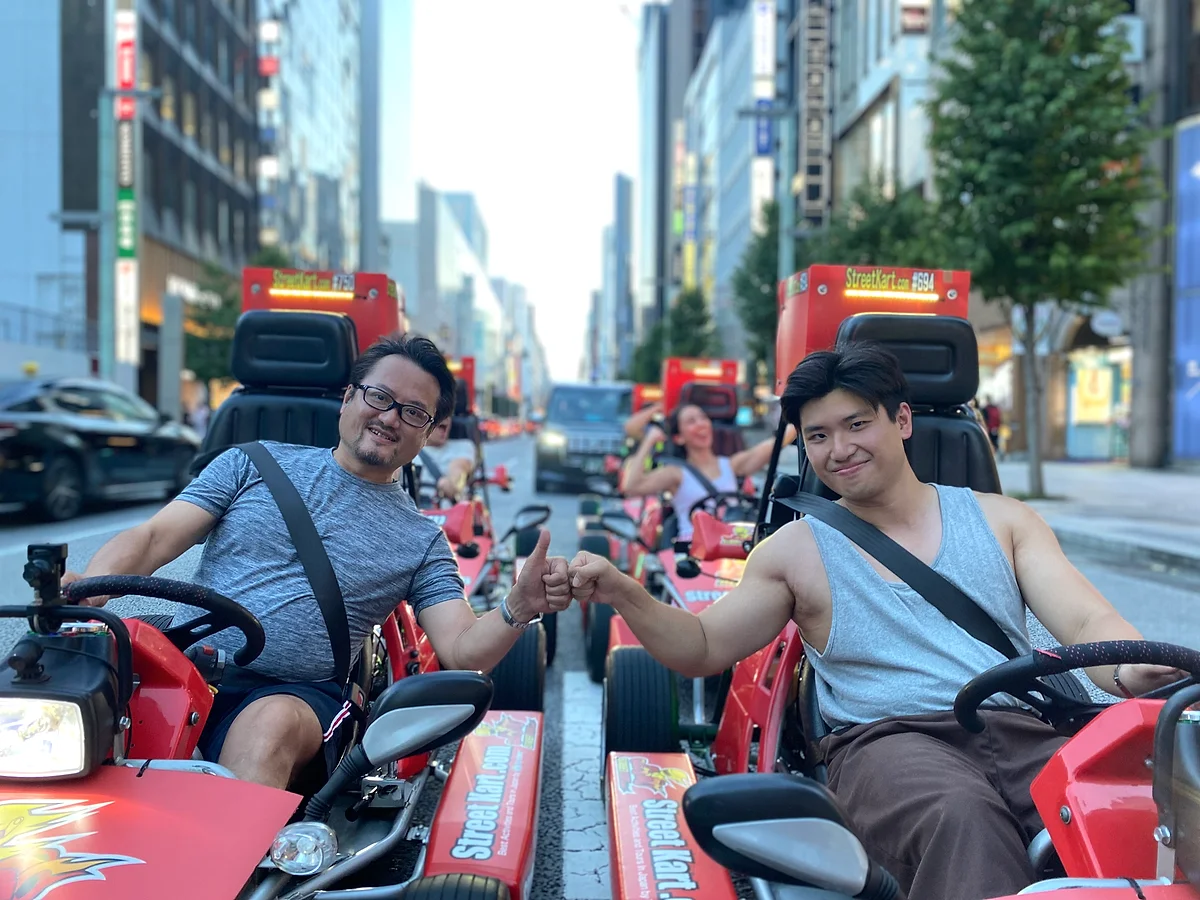
A street kart has a low seat and no roof. Your eyes sit much lower than usual, and the sounds of the city bounce off the building walls straight into your ears. The wind doesn't only hit you head-on. It also slips sideways through the gaps between buildings. If you've ridden once, that feeling has probably stayed with you somewhere.
Let's be honest: the first time, you had no attention to spare for any of that, right? Getting used to the feel of the steering wheel and keeping up with the guide in front took everything you had. In surfing terms, you were at the stage where all you think about is standing up on the board. You could only see your own feet.
The second time is different! Your hands remember how to drive, so your eyes have room to wander. It's like a surfer who can finally ride a wave and starts reading the shape of the swell. You're driving the same Shibuya, yet you take in far more of the scenery. This is where the real fun starts.
That said, being used to it doesn't mean you can tune out the safety briefing after check-in. The briefing covers how to operate the kart, the day's route, and what to watch out for while driving. Even at the same store as last time, a different tour can mean different roads. While you wait to set off with your helmet and goggles on, think back to where your hands tensed up last time. That's where preparing for your second ride begins.
The Sides of Shibuya to Look For the Second Time
One thing to confirm first: Street Kart runs guided tours, and each tour has a set course. So what makes the second ride fun isn't where you go. It's what you notice along the same roads. That's the interesting part.
Slopes, and a Station Area That Keeps Building Upward
Shibuya is a city of slopes. Inclines you barely notice on foot, your body picks up first when you're sitting this low. Going uphill, your back sinks slightly into the seat. Heading downhill, the city suddenly opens up in front of you. The second time, I want you to feel this.
Tours from the Shibuya store and Shibuya ANNEX include a course that runs from the Shibuya Scramble Crossing through Dogenzaka toward Omotesando and Harajuku. Dogenzaka is, as the name ("zaka" means slope) suggests, a street on a hill. If you drove this course the first time, you may remember the moment your body tilted after you cleared the crossing. This time, try to work out exactly where that tilt starts and where it ends.
Around the station, pay attention to how tall the buildings are, too. Shibuya Hikarie, Shibuya Stream, and the 230-meter Shibuya Scramble Square. Large-scale redevelopment has stacked the station-area skyline higher and higher.
Some cities have wide skies and spread out sideways. The area around Shibuya Station is the opposite: it's layered vertically. Looking up from just above the pavement, you can see exactly how those layers stack.
But! Only look up while you're stopped at a light. While moving, keep your eyes on the kart ahead and the guide. You can take in the scenery all at once when you stop.
From Harajuku to Omotesando, the Air Changes
The Shibuya store and Shibuya ANNEX route and its surroundings take in places like Takeshita Street in Harajuku, Omotesando, Meiji Jingu, Yoyogi Park, and NHK Hall. On your second ride, pay less attention to the sights themselves and more to the points where one place turns into the next.
Around Takeshita Street in Harajuku, there's color everywhere. Signs, shop windows, all of it lively, noisy, and fun. Then you turn onto Omotesando and the tone drops a notch. A straight line of zelkova trees, lined with distinctive buildings by well-known architects, such as Omotesando Hills and Tokyu Plaza Omotesando Harajuku. The avenue is also known for its winter illuminations, and as the seasons change, so do the color of the leaves and the way the light falls.
Let me pause here for a moment.
Meiji Jingu is surrounded by a forest of about 700,000 square meters. As you get close, the air feels just slightly cooler. The difference is so small you might think you're imagining it. But on a vehicle with no roof, even what you'd dismiss as imagination reaches your skin. The breeze on the back of your neck is different from the asphalt wind of a moment ago. You're driving through the middle of the city, catching a faint scent of trees and earth. If you love the outdoors, it's the kind of moment that makes you smile without meaning to.
The Shibuya that was "the city of the crossing" the first time starts to look like "a city where slopes, tree-lined avenues, and forest connect" the second time. I think that change is the biggest reward of going back.
Planning for a Big Group: How to Line Up Everyone's Schedules
Now, this part is for those heading out with a large group of friends! Your second-ride crew may include people who came last time and people riding for the first time. That's exactly why planning matters.
First, the tour format. Details such as how many people can join the same session and how group size is handled should be confirmed by telling them your headcount when you get in touch to book. For details, please check the official website (kart.st).
Next, dates. Weekends book up quickly, so booking early is recommended. With a big group, just finding a day that works for everyone is a job in itself. So start by choosing one organizer! The organizer suggests a few candidate dates and collects replies from everyone. Once the date is settled, get in touch to book right away. If you hesitate while waiting for replies, the slot you wanted may fill up.
It's safest to check driver's licenses before booking. Every driver needs to meet the requirements, and if even one person turns out not to on the day, the whole group's plan falls apart. Have everyone check the license requirements and what to bring on the day on the official website. Even just having the organizer drop the link into the group chat makes a big difference. The karts are single-seaters, and passengers are not allowed. Non-drivers can't come along by riding next to someone, so make sure every member knows this too.
One more important thing: make sure everyone knows which store you booked. Shibuya has both the Shibuya store and Shibuya ANNEX, and they're almost in the same spot. Share the name and address of the store you booked with everyone.
Use public transportation to get there. The stores have no parking. The Shibuya store and Shibuya ANNEX are about a 5-minute walk from Shinsen Station on the Keio Inokashira Line and about a 10-minute walk from Shibuya Station. With a big group, it's safest to pick a single station as your meeting point. The Hachiko statue is a famous meeting spot, but it gets so crowded that finding each other can be a hassle.
It also helps if the organizer adds a note about clothing. Wear closed-toe shoes, ideally sneakers. Avoid open-toe shoes like sandals, heels, and skirts or dresses. Wear clothes that are easy to move in, plus a jacket suited to the season. In summer, a hat, sunglasses, and sunscreen will come in handy. Keep your belongings in a small bag. The stores have lockers for small items, but they're not suited to large luggage like suitcases. If any members are stopping by mid-trip, talk ahead of time about where they'll leave their large luggage.
Sharing weather info in advance also keeps things from getting messy. In light to moderate rain, tours run as scheduled and raincoats are provided. In heavy rain or typhoons, tours may be canceled, in which case your options are a shortened tour with a refund of the difference, changing to another day, or canceling for a full refund. With a big group, a new date may not work for everyone. If the organizer asks for everyone's preference ahead of time, nobody has to scramble on the day.
Check on language, too. Guidance on tour day is basically in English. Guidance in Japanese or other languages depends on the staff that day and can't be guaranteed. The website is available in 22 languages. Organizers, try sharing the page in each member's preferred language in the chat. If some members aren't confident in English, have them send any questions through the official website in advance. Having them stand next to a friend who's good at English during the briefing is another handy trick within the group.
For cost, prices vary by season and time of day, so please check the latest rates on the official website (kart.st). Share what you find with everyone before discussing how to split the bill. Calculating with outdated info leads to trouble later.
Bookings are accepted via Facebook, LINE, and email. Choose whatever your group normally uses, and the organizer can easily pass messages along to everyone as they are.
Shibuya Before and After the Drive
Setting aside time before and after the tour adds a lot to your second Shibuya visit! The places listed here aren't on the tour course. They're places you can drop by before or after.
Before the drive, I recommend Shibuya Sky, the observation deck at Shibuya Scramble Square, which is about a 10-minute walk from the store. From above, the "slopes" and the "vertically stacked station area" I mentioned earlier spread out like a map. Get a sense of the whole city from above, then drive the same streets from just above the pavement. It's a way to connect two viewpoints at very different heights in a single day.
With a big group, not everyone will want the same thing before the ride. In that case, don't force it. Split into an observation deck group and a coffee group. Spend time somewhere like Starbucks Shibuya Tsutaya, about 8 minutes on foot from the store, or Blue Bottle Coffee Shibuya, about 10 minutes on foot, and just decide on a meeting place and time. Leave plenty of time to regroup. Shibuya's crowds slow you down more than you'd expect.
After the drive, try walking Omotesando, about 15 minutes on foot from the store. The zelkova avenue you sped through in the kart, you now take in at your own walking pace. When the speed changes, the same avenue shows you different things. If you have the time and energy, extend your walk to Meiji Jingu or Yoyogi Park, about 20 minutes away. I find a walk in the forest is just right for unwinding a body still a little buzzed from the ride.
While you walk, ask each member, "What stood out to you the most?" Even though everyone drove the same roads, the answers may differ: some will name the slopes, some the trees, some the crowds at the crossing. All the more so in a group mixing second-timers and first-timers. Those answers become candidates for what to look for on your next ride.
If you want photos, I recommend taking them on foot after the drive. For the Scramble Crossing, the second floor of Starbucks and the rooftop of MAGNET are well-known photo spots. For group photos, find a spot where the sun is behind the photographer, at everyone's backs, so faces don't come out dark. It's a small thing, but it makes a big difference in how the photos turn out.
For food, Dogenzaka Ramen Yokocho is about 8 minutes on foot from the store and Shibuya Niku Yokocho about 10 minutes. Whether a big group can sit together depends on the restaurant, so it's easier to assume you'll be split across tables. One group photo at the end is enough to bring everyone back together.
Also, plan to take your trash home with you. Keep a small bag in your pocket and you won't have to hunt for a trash can in the city. Whether in a park or on the streets, leave the place cleaner than you found it. Just as I try to respect nature, I want to treat the city the same way. I truly believe that's the most enjoyable way to spend the day.
On to Booking Your Next Shibuya Ride
On your second visit, Shibuya looks like a different city even on the same roads. The tilt of the slopes, the layers of buildings, the shade of the trees, the air of the forest. This time, you go out and pick up the scenery that flowed past beyond the crossing on your first ride. That's how to drive it the second time.
If you're going as a group, the first step is choosing an organizer! Suggest candidate dates, check everyone's license requirements, and be clear about which store you're booking. Weekends book up quickly, so once your dates take shape, get in touch early. Tour details and booking contacts are all on the Street Kart official website.
The light turns green. It's the same crossing as last time.
But this time, you should be able to see all the way to the top of the slope beyond it. Come on, let's go drive Shibuya one more time!
This article was originally written in Japanese and translated using AI. Some expressions may read unnaturally, and we appreciate your understanding. For the most accurate and up-to-date information, please refer to the official site at kart.st.
Street Kart is not affiliated with Nintendo or the Mario Kart series in any way. We do not provide costumes of Nintendo characters, and such costumes may not be worn during tours even if brought by participants.