
Can a Group with Kids Join a Street Kart Tour in Tokyo? How to Check, Working Out from the Rest of Your Day
Can a Group with Kids Join a Street Kart Tour in Tokyo? How to Check, Working Out from the Rest of Your Day
You're in Tokyo with a group of six: four adults and two kids. Then someone says, "I want to drive a kart through the city!" A few others jump in: "Me too!" That's the spirit. Trips should be like this.
But the first thing that crosses your mind is: "Can we all go?" The answer depends less on the karts themselves than on how the group spends the time before and after the tour.
This article goes step by step through how a group with children can check whether a street kart tour fits their plans, with the rest of the day as the starting point. I won't tell you that a group of a certain size or age "can" or "can't" join. Instead, let's work out together what to check, and in what order, so the whole group's day fits together neatly.
First, figure out who drives and who waits
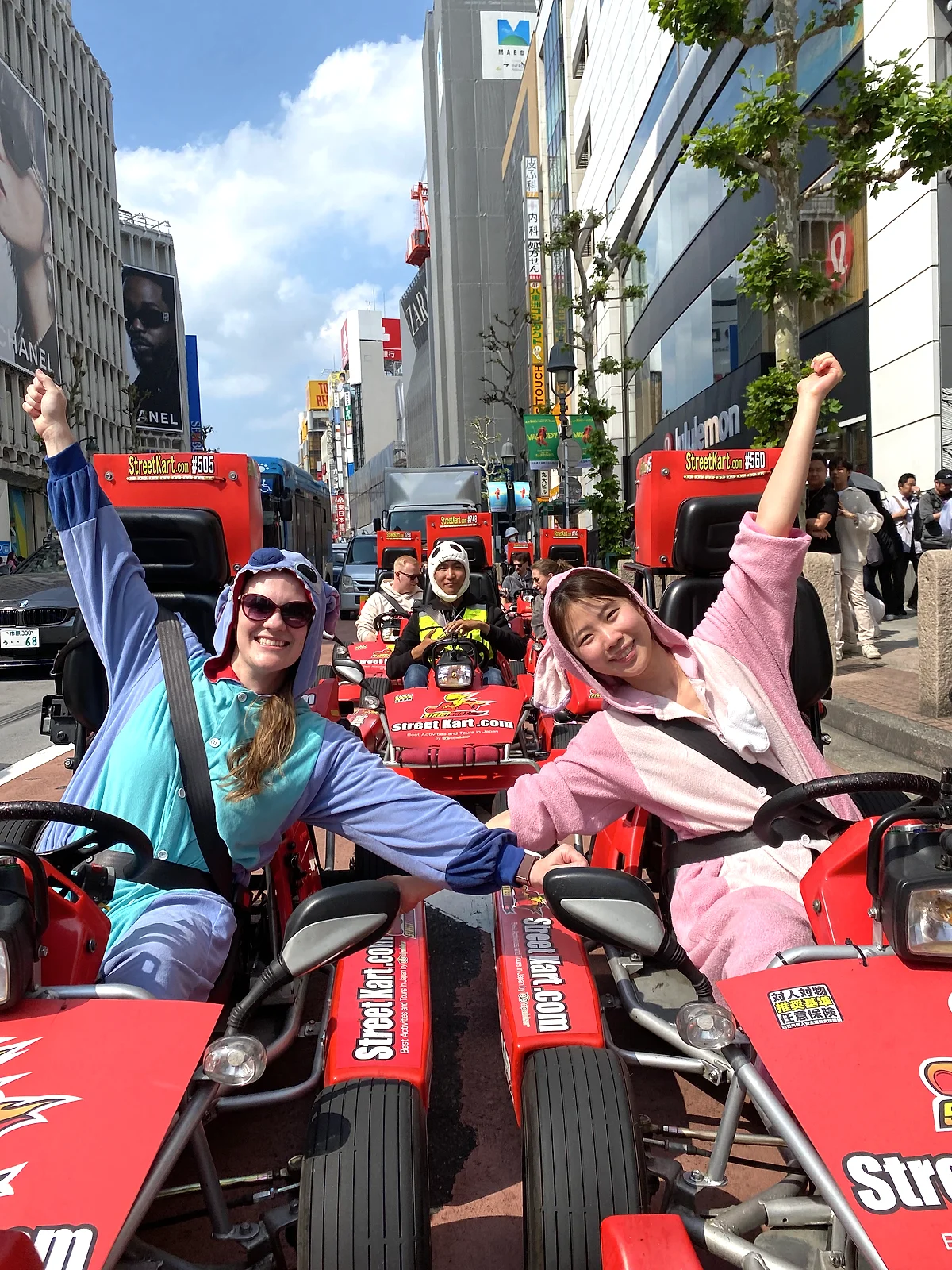
The starting point is simple. Each kart seats one person. There's no passenger seat and no back seat. A child can't sit on your lap or beside you while you drive.
Share this with everyone first. Once the whole group knows it, the rest of the planning goes surprisingly fast. If you build your plans assuming the kids can ride along, you'll end up redoing everything on the day. Nobody wants that on a vacation morning.
Next, each person who wants to drive needs to check that they meet the driving requirements. You can find the rules on driver's licenses and age on the official website (kart.st). What you need depends on which country issued your license and what kind of document it is, so I won't pull out a partial list here. Anyone who wants to drive should open the page and check their own situation.
This part really matters, so it's worth a moment. A common mistake is for one person to decide for everyone: "We're probably all fine." The person who will be driving is the one who checks the requirements. Everyone checks for themselves, with their own eyes.
Once you've done this, the group splits into two: the people riding karts, and the people spending the time doing something else. The kids go in the second group, along with at least one adult to look after them. Now we get to the main topic, because this is where the rest of your day comes in.
Building the group plan backward from the rest of the day
If you're used to trips where everyone piles into one car and stays together all day, splitting up might feel a little sad. But Tokyo makes splitting up easy. Trains run frequently, and lots of sights are packed within walking distance of the stations. Split into two groups for a while and meet up later. Getting around this way suits Tokyo well.
Here's the order to think in:
First, decide where the non-riders will go and what they'll do. Next, pick a store that's easy to get to and from that place. Finally, decide where and when you'll meet up.
If you do it the other way around and choose the store first, then look for something for the waiting group to do, the kids tend to get bored or the trips get long. Plan for the waiting group first. That's the trick!
How long the tour takes depends on the plan. Check when you book, then build the waiting group's plans around that time. It's easier for the waiting group if they choose activities that still work when timing shifts a bit. Don't schedule somewhere with a strict closing time or last entry right at the end of the tour.
Plan to get around mainly by public transport. The stores don't have parking, and heavy traffic could make you late for your booking. Riders should take the train to the store. If the waiting group is spending time far from the store, driving is also an option. Even then, pick a station as your meeting point.
There are seven stores in Tokyo. However, Akihabara Store 1 and Store 2 are at almost the same spot, and so are the Shibuya store and Shibuya Annex. So there are fewer areas to choose from than the number of stores suggests.
Below are some ideas for the waiting group in each area. These are places to spend time separately from the tour.
If you use an Akihabara store: wait at Ueno Park
The Akihabara area pairs well with Ueno Park, about five minutes away by train. The park has Ueno Zoo, the Tokyo National Museum, and the National Museum of Western Art. The kids and their adults head to the zoo while the riders head to Akihabara. Wave goodbye for now.
Within walking distance, Kanda Myojin Shrine is about 10 minutes from the store on foot. It's known as the guardian shrine of old Edo. The Electric Town itself surrounds the store, and Yodobashi Camera Akihabara is about a three-minute walk away. When you can't predict how long you'll be waiting, it really helps to have an indoor place to wander right nearby.
The simplest plan is to meet at either Akihabara Station or Ueno Station. Akihabara Station is about a 5, 7 minute walk from the store. The riders walk to the station after the tour, and the Ueno group comes over by train. That way, nobody has to wait long.
A quick word on what the riders will see. The Akihabara store's tours list the red-brick Tokyo Station building and the streets of Ginza as landmarks along the route. When you meet up, riders can tell the kids, "I saw the Wako clock tower!" For a child who didn't ride, that turns into a place to go see on foot later. The waiting time leads to something to look forward to.
If you use a Shibuya store: wait at Yoyogi Park or Meiji Jingu
There's plenty of green space near the Shibuya store and Shibuya Annex. Yoyogi Park is about a 20-minute walk from the store. It's a huge green space in the middle of the city, great for kids who are itching to run around. Meiji Jingu, also about 20 minutes on foot, has a sacred forest that opens up once you pass through the great torii gate. You'll probably be surprised to find somewhere this quiet so close to busy Shibuya.
A quick note from someone who loves the outdoors: both places are more pleasant if you plan to take your trash home with you. If you're having a snack in the park, bring an extra bag. Cleaning up becomes much easier.
Now, the Shibuya tours list Harajuku and the zelkova-lined avenue of Omotesando as landmarks on the route. Hearing that, you might think: "Let's have the kids stand on Takeshita Street and wave as the karts go by!"
…I completely get it. But I don't recommend it.
From the outside, you can't tell exactly when the tour will pass a given spot. Waiting on a packed sidewalk, watching the traffic, for karts that could come at any moment is risky for kids. It's safer for the waiting group to relax in the park or at the shrine and ask "How was it?" after you meet up. Both groups get more out of their time that way, too.
For meeting points, Shinsen Station is about a 5-minute walk from the store, and Shibuya Station is about 10 minutes. If you're coming back from Yoyogi Park or Meiji Jingu, Harajuku Station is another option. Getting a group of six or more together at crowded Shibuya Station is harder than you'd think. Agree on the exact ticket gate by name.
If you use the Shinagawa store: choose between Shinagawa Shrine and Tennozu Isle
The Shinagawa store is in Kita-Shinagawa, and Shinagawa Shrine is about a 5-minute walk away. At the top of its stone steps is a Fujizuka, a miniature Mount Fuji, so you and the kids can enjoy a small "mountain climb." If the wait is on the short side, this should be plenty.
For a longer wait, head to Tennozu Isle, about 20 minutes on foot. Art galleries and cafés line the canals, and you can stroll along the water at a relaxed pace. If being near the sea or a river calms you down, you'll probably like the feel of this place.
If it rains or the kids get tired of walking, it's handy to know about atré Shinagawa, which connects directly to Shinagawa Station. Shinagawa Station is about a 10-minute walk from the store, or about 3 minutes to Kita-Shinagawa Station on the Keikyu Line. Shinagawa is also a Shinkansen stop, so the group can arrive in Tokyo by Shinkansen and split up right there in Shinagawa.
For riders, the Shinagawa store's tours list distant views of the Rainbow Bridge and Tokyo Tower as landmarks.
If you use the Tokyo Bay store (Shinkiba): wait at Kasai Rinkai Park
The Tokyo Bay store in Shinkiba is a bit different from the other stores. There aren't many sights within walking distance. It's best to assume the waiting group will get around by car in this area.
For time with kids, Kasai Rinkai Park, about 15 minutes away by car, is a good option. It's a large park facing Tokyo Bay, with a giant Ferris wheel and the Tokyo Sea Life Park aquarium. Kids with energy to burn can spend plenty of time by the sea. Odaiba is about 10 minutes away by car and has large indoor facilities like DiverCity Tokyo Plaza.
The Tokyo Bay store's tours list the Rainbow Bridge and Tokyo Tower as sights visible from the route. According to the store's materials, the 798-meter suspension bridge is lit up in seven colors at night. If you want night views, check the available time slots when you book.
Shinkiba Station makes an easy meeting point. It's about an 8-minute walk from the store and served by the JR Keiyo Line, the Tokyo Metro Yurakucho Line, and the Rinkai Line. Decide ahead of time whether the waiting group will drive back to the station, or which line they'll take if they come by train. That alone will keep you from missing each other at the gates.
Four things to sort out as a group before booking
Once you've narrowed down the store and area, get everyone on the same page before booking. If you send an inquiry while these points are still vague, you'll end up going back and forth many times.
First: the exact number of drivers. "About four of the six of us" isn't good enough. Count only the people who have finished checking their license requirements. Kids don't count as drivers. It also helps to know how many people will be in the waiting group when you plan the day.
Second: candidate dates. Weekends book up quickly, so if your schedule allows, consider weekdays too. If you pick a first and second choice from the days when the whole group is in Tokyo, things go more smoothly.
Third: language on the day. Tours are generally guided in English. Guidance in Japanese or other languages depends on the staff that day and isn't guaranteed. If someone in your group isn't comfortable with English, it's a good idea to decide in advance that a member who understands English will drive near them. If anything worries you, ask about it when you book.
Fourth: whether your group can have a tour to itself. This is worth checking in advance, but I can't give you a definite answer here. Don't build your plans assuming you'll be riding as a private group. Check the official website for details or ask when you book.
You can book through Facebook, LINE, or email. Contact details are on the Street Kart official website, which is available in 22 languages. Choosing one person in the group to handle checking the requirements keeps things simple.
What to know about Street Kart before riding as a group
Let's take a moment to go over what Street Kart actually is. Riders and the waiting group both need this as background when making plans.
The most important point is that every tour is led by a guide. You can't just drive wherever you like. You follow the guide along a set course for each store. Every tour has a trained guide in the lead.
There are nine stores nationwide: seven in Tokyo, one in Osaka, and one in Okinawa. This also helps with planning. Even within Tokyo, what there is to do nearby is completely different between Akihabara, Shibuya, Shinagawa, and the Tokyo Bay store in Shinkiba. If you choose a store close to your hotel or your other sightseeing plans, getting around is that much easier.
Then there's the kart itself.
The moment you start moving, your eye level drops way down. The buildings feel like they're looming over you. The sounds of the intersection and the wind reach you directly, with nothing in between. I think it's like waiting for a wave on a surfboard, taking in everything moving around you with your whole body. It's only natural that riders want to describe this feeling, with gestures and all, as soon as they meet up with everyone.
The track record is useful to know too. As of November 2023, across all stores, there had been more than 150,000 tours, more than 1.34 million customers, and more than 20,000 reviews, with an average rating of 4.9 out of 5. These are all November 2023 figures, not current ones.
On the day: from splitting up to meeting up
On the day, the five minutes before you split up are what count most!
Gather everyone once, at a ticket gate or similar spot, and go over the meeting place, the rough time, and how you'll contact each other. Setting up a group chat in a messaging app makes it easier to get in touch if someone's running late.
Riders should head to the store with plenty of time before their booking. Being late affects the whole tour. The waiting group should take it easy and go at the kids' pace. If you pack in too much, the kids may be worn out by the time you meet up. Going at your own pace is fine.
While driving, riders can't touch their phones. If a "Where are you?" message from the waiting group goes unanswered, that just means they're focused on driving. Agree at the start that you'll get in touch after the tour.
After the tour, riders still need to return the karts and pick up their belongings. If the waiting group leaves some slack in the meeting time, nobody has to rush.
And then you meet up. From here on, it's time for everyone.
From Akihabara, head to Tokyo Station or Ginza. From Shibuya, head to Omotesando. Riders can go back with the kids, on foot, to see the places they saw on the tour. Plan it that way, and the day doesn't feel like just a day of waiting around for the kids who couldn't ride. From Shinagawa, you could also head to Tennozu Isle after the tour, separate from the sights on the route.
Start by deciding who's riding
When you're adding a street kart tour to a trip with kids, it can seem like there's a lot to check. But if you go in order, it isn't hard.
Make sure everyone knows the karts are single-seaters. Each person who wants to drive checks the requirements. Decide what the waiting group will do, then choose the store. Settle the meeting place and how you'll stay in touch ahead of time.
That's the whole process.
Weekends book up quickly, so once your itinerary is set, it's best to act early. After the drivers have checked their requirements, look at the stores and plans on the Street Kart official website, then reach out through Facebook, LINE, or email.
The few hours you spent apart become stories everyone shares the moment you meet up. "We saw this!" "Well, we saw this!" Enjoy an evening full of voices talking over each other.
This article was originally written in Japanese and translated using AI. Some expressions may read unnaturally, and we appreciate your understanding. For the most accurate and up-to-date information, please refer to the official site at kart.st.
Street Kart is not affiliated with Nintendo or the Mario Kart series in any way. We do not provide costumes of Nintendo characters, and such costumes may not be worn during tours even if brought by participants.