
Taking a Group with Some New Faces Street Karting in Tokyo: Planning Everything from Scheduling and Picking a Location to What Happens After the Ride
Taking a Group with Some New Faces Street Karting in Tokyo: Planning Everything from Scheduling and Picking a Location to What Happens After the Ride
A friend of a friend. A pair you met at the guesthouse just last night. Someone a coworker brought along whose name you only half remember.
That's pretty much what a group coming together in Tokyo looks like, right?
And that group has just agreed: "Let's go street karting!" Great. But now the real planning starts. With close friends, you can get by on "we'll figure it out." Once people who've never met are in the mix, that doesn't work. Some people don't have each other's contact info. Some are too polite to say what they really think. Everyone arrives on a different day. All of this is completely normal.
This article walks you through the whole thing in order, from the first invite to the moment everyone heads home. Whether you can book for the number of people you want is something to check on the official website (kart.st) or when you make your reservation. What this article covers is the thinking behind it: what to decide, and in what order, so the day goes smoothly.
Step 0: Pick a "Point of Contact" Before You Pick an "Organizer"
At an Australian BBQ, it's completely normal for one or two people to be strangers. Someone's grilling the meat, someone's handing out beers, and before you know it, everyone's chatting. The reason it works so well is that it's clear who the host is.
Street karting is the same. The first thing to decide isn't who runs the whole show. It's this: narrow reservations and communication down to one point of contact.
The person who handles the booking. The person who shares the meeting spot on the day. The person who fields last-minute changes. If that's all the same person, the new members will know, "If I'm stuck, I can ask them." That alone should put people a lot more at ease.
The best point of contact isn't necessarily the center of the group. It's someone who can already reach everyone. If you choose someone who's only connected to the others as a "friend of a friend," information has to take a detour. And somewhere along that detour, it stops reaching someone.
Once you have a point of contact, set up one group chat with everyone in it. The more one-on-one messages there are, the more often you get "Oh, that one person never heard about it." People who don't know the group are usually the most hesitant to ask for things to be repeated.
Step 1: Check Who Can Drive Before You Set a Date
You'll want to lock in a date right away. Totally understandable! But first, just one thing.
Does everyone meet the requirements to drive?
Karts are single-seaters. Everyone who takes part is a driver. Riding behind someone else isn't an option. And whether a given driver's license will work depends on each person's situation. With close friends, you can just ask, "What's your license situation?" With someone you've just met, it's a bit more awkward to ask.
The trick here is for the point of contact to send everyone the same message. The official website (kart.st) lays out how driver's licenses are handled, so send it to everyone at once: "Everyone, please read this and check whether your license works." Instead of singling anyone out, everyone goes through the same process. That way nobody feels awkward.
This article deliberately doesn't list the required documents or conditions. If you pull out only part of the information, someone will end up missing the parts that were left out. Have everyone check the details for themselves on the official website.
Once people check, it may turn out that someone can't take part. If so, don't pressure them to come along anyway. If they join the group for food or a walk after the ride, they won't feel left out. Even on a mountain hike, not everyone has to take the same route. Some people can just meet the group at the summit.
Step 2: Split Scheduling Between "The Person Who Proposes Dates" and "The People Who Choose"
Once you know who can drive, it's time to set the date.
This is where groups with new faces often run into trouble. Ask everyone "When works for you?" and the most reserved people will answer, "Any day is fine." In the end, the date gets set around whoever speaks up the loudest, and later you hear, "Actually, that day…" This happens all the time.
The approach we recommend: the point of contact proposes about three dates, and everyone replies with only the dates that don't work for them. "Which of these don't work?" is much easier to answer than "When works for you?"
If you're gathering for a weekend trip to Tokyo, ask about arrival and departure times at the same time. Even on the same three-day, two-night trip, one person might arrive Friday night while another doesn't join until Saturday afternoon. Right after arriving, people are tired from traveling and still sorting out where to leave their bags. The safest bet is a day when everyone is in town, with some breathing room before and after.
One more thing: weekends book up quickly. Weekend-trip groups naturally end up with most of their options on Saturday or Sunday. Once you've settled on a date, move on to booking early. If you tell everyone while narrowing things down that "weekends are sometimes full," there won't be any friction if you have to fall back to your second choice.
Step 3: Choose a Location Based on Both "Scenery" and "How Easy It Is to Get There"
Street Kart has 9 locations nationwide, and 7 of them are in Tokyo.
This part is easy to misunderstand, though, so let's pause for a moment. Akihabara Store 1 and Store 2 are in almost the same spot, and so are the Shibuya store and Shibuya Annex. They aren't spread across seven different areas of Tokyo. Think of the real choice as "which area do we start from?"
When a group includes people who've never met, there are two things to base the choice on. Does the scenery on the route suit the group? And can everyone get to the location easily?
Shibuya & Shibuya Annex: For groups who want to soak up the city's energy
Routes from the Shibuya locations take in sights like Shibuya Scramble Crossing, the area around Shibuya Station with the Hachiko statue, Takeshita Street in Harajuku, and zelkova-lined Omotesando. The areas around Meiji Jingu Shrine, Yoyogi Park, and NHK Hall are also listed as highlights of the route.
Scramble Crossing is an easy conversation starter, even among people who've just met. "I've seen that on TV!" One line like that gets the conversation going. The store is about a 5-minute walk from Shinsen Station on the Keio Inokashira Line, or about 10 minutes from JR Shibuya Station. Even if everyone is staying in different places, having Shibuya Station as a landmark helps a lot.
Akihabara Store 1 & Store 2: For groups who want to see old and new Tokyo in one go
Highlights of the routes from the Akihabara locations include the red-brick Marunouchi building of Tokyo Station, Ginza with the Wako clock tower, and Akihabara's Electric Town, packed with signs. The areas around Kanda Myojin Shrine and Ochanomizu are also listed.
From a grand station building that opened in 1914 to a flood of Electric Town signs: that's quite a range! Even in a group with very different interests, someone is likely to come across the view they were hoping to see.
Tokyo Bay (Shin-Kiba): For groups who love wide-open views
Highlights from the Shin-Kiba location include the 798m-long Rainbow Bridge, the 333m-tall Tokyo Tower, and the scenery around Odaiba. The bayside roads, which run between warehouse districts and the sea, feel completely different from driving between tall buildings. At night, Rainbow Bridge is lit up in seven colors. The store is about an 8-minute walk from Shin-Kiba Station.
Shinagawa: If someone is joining you by bullet train
Rainbow Bridge and Tokyo Tower are also listed as highlights on routes from the Shinagawa location. Other sights include the high-rises around Shinagawa Station, the Takanawa area where Sengakuji Temple stands, and the waterfront Shibaura and Tamachi areas. The store is about a 3-minute walk from Keikyu's Kita-Shinagawa Station, or about 10 minutes from JR Shinagawa Station. Since the Shinkansen stops at Shinagawa Station, it's an easy option for groups with members coming in from outside Tokyo.
Whichever location you choose, you'll drive that location's tour route, with a guide leading at the front. So picking a location based on the scenery you like is really picking which route you'll drive. That's what should settle it.
Step 4: Booking and Sharing Info: What to Tell Everyone at This Stage
Once the location and date are set, the point of contact goes ahead with the booking. Check the official website (kart.st) for the latest information on how to book and who to contact.
Before booking, the first thing to tell everyone is that tour guidance on the day is generally in English. Guidance in Japanese or other languages depends on the staff working that day, so it can't be guaranteed. If anyone is worried about their English, it's a good idea to contact the company through the official website before booking. You can also mention that the official website is available in 22 languages. That applies to the website only, not to the guidance on the day.
One more thing to check before booking is whether you'll be driving with other participants. Street Kart runs as guided tours. Whether your group can ride on its own is something to check on the official website or ask about when you book. Either way, you'll be following the guide, so you don't have to coordinate with the person next to you.
Once the booking is confirmed, it's helpful to post the date, location name, and nearest station together in the group chat.
Money is also something you'll want to sort out early with a group of people who've just met. However, prices vary by season and time of day, so please check the official website (kart.st) for the latest information. If the point of contact uses that price to post how you'll split costs in the group chat, nobody will be fumbling with their wallet on the day.
Step 5: Meet at the Station on the Day, and Don't Come by Car
On the day, the first thing to remind everyone about is how to get there.
The stores don't have parking. Everyone needs to come by public transportation. Make sure you tell everyone this.
Rather than meeting in front of the store, we recommend meeting at the ticket gates of the nearest station. People who've just met won't have memorized each other's faces yet. If everyone waits separately in front of the store, they'll keep their distance, wondering, "Are those people in our group…?" Get everyone together at the station gates first, then walk to the store as a group. Those few minutes of walking make a perfect time for introductions.
The stores have restrooms and Wi-Fi, and there's a convenience store within a 5-minute walk of every location. Even so, make it a rule that anyone who might be late contacts the point of contact right away. One person's lateness affects everyone's plans. That's the tricky part of going as a group.
As for clothing, the basic rule is to put ease of movement first. Just like with surfing or hiking, flowy clothes and shoes that slip off easily get in the way when you're moving around. Check the specific dress code on the official website and share it with the group.
Step 6: While Driving, Follow Traffic Rules and the Guide's Instructions
Once check-in and the briefing are done, it's finally time to go!
From here on, each person's safety matters more than any group planning.
Street Kart tours are led by trained guides, and participants follow behind them. What matters isn't speed. It's keeping your distance from the kart in front and staying in line. If someone in your group falls behind, don't try to force your way back to them. Managing the route and keeping an eye on safety is the guide's job.
Don't pick up your smartphone while driving. We completely understand wanting to take photos. But taking a hand off the wheel for even a moment can cause an accident, whether you're on a wave or on a public road. Take in the scenery with your eyes and your whole body, and save the photos for before or after the tour. That's all you need.
If the crepes on Takeshita Street catch your eye, save them as a treat for after the tour.
If anyone seems nervous, say a quick word before you start: "You're just following the guide, so go at your own pace." Everyone tenses up at first, the same way a beginner surfer tries way too hard on their first wave. As you keep driving, your shoulders should gradually relax.
Why Street Kart works so well for groups with new faces
Let's pause here for a moment and think about it. Why is street karting such a good match for groups that include people who've never met?
First, nobody has to lead. The guide drives at the front, and the route is already set. "Where should we go next?" "Wouldn't this road be better?" You skip the kind of back-and-forth where people who've just met tiptoe around each other. Everyone lines up under the same conditions, in the same line. That's it.
Second, everyone is a driver. Since the karts are single-seaters, there's no split between the driver and the passenger. At a restaurant, people tend to divide into talkers and listeners. On a kart, everyone has their hands on the wheel.
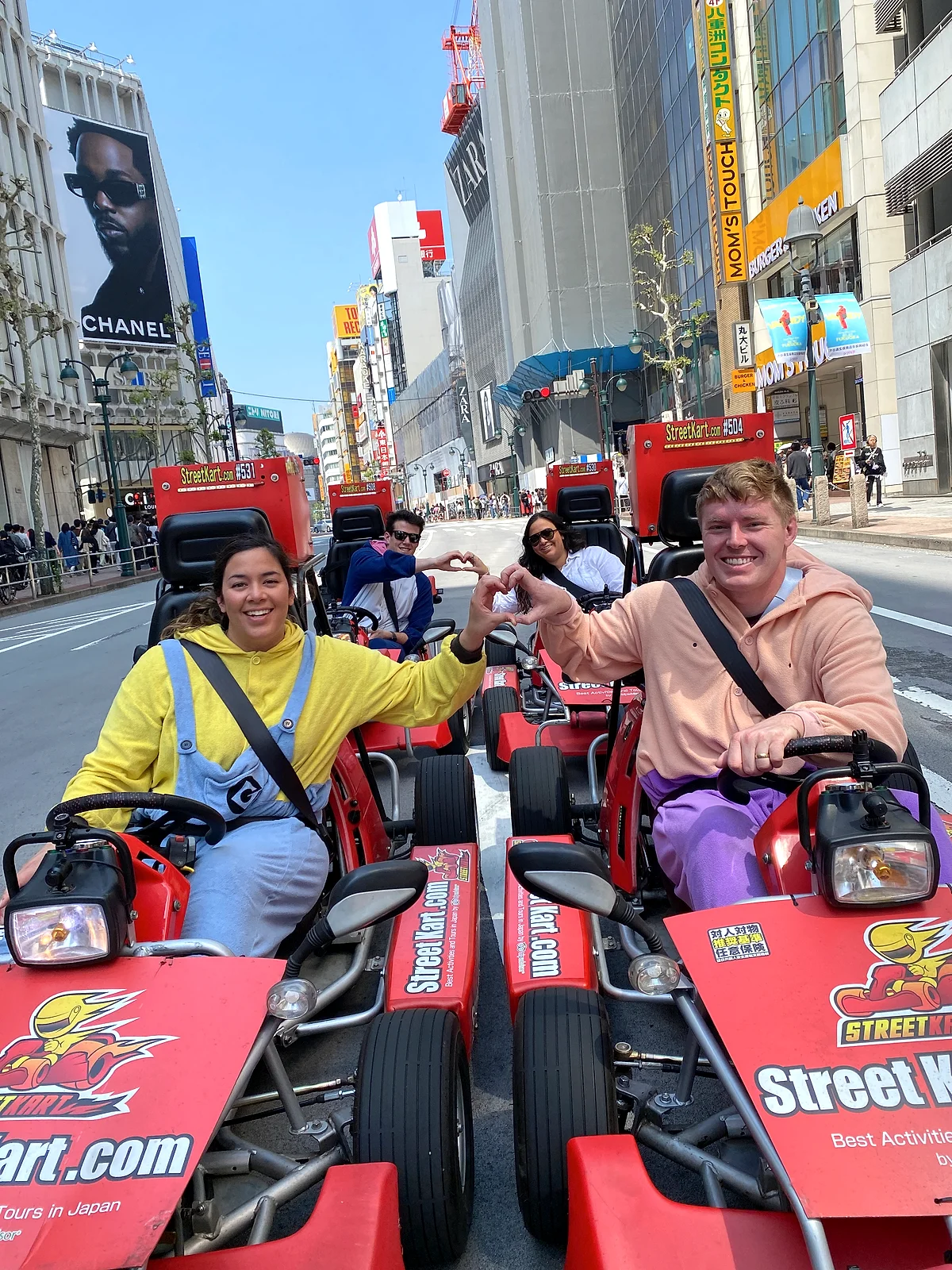
Third, everyone physically feels the same things. Take a moment to picture this. From the low seat, building walls seem to tower overhead. At a red light, the engines in the next lane rumble right beside you. On a seaside route, wind with a hint of salt hits you head-on. Even with someone you can barely talk to, "That wind was amazing!" comes across with just a look on your face.
Fourth, you come away with plenty to talk about. "When we were waiting at that intersection, someone waved at us, right?" "Tokyo Tower was redder than I expected!" You saw the same scenery from the same eye level, and that gives you something to talk about afterward. Doing something together brings people closer faster than any number of introductions. It works the same way as sitting around a campfire, where even strangers somehow end up getting along.
For reference, as of November 2023, Street Kart had served over 1.34 million customers across all locations, with more than 20,000 reviews and an average rating of 4.9 out of 5. These figures are all from that time, so check the official website for current numbers.
Step 7: After the Ride, Keep the Group Together
Right after getting out of the karts, a group is usually a little buzzed.
Split up while you're still riding that high? Honestly, that'd be a waste!
For each location, pick one or two places you can stop by before or after the tour. When people who just met say "Let's meet up again," it's usually during this detour.
At the Shibuya locations, Dogenzaka Ramen Yokocho is about an 8-minute walk away, and Shibuya Niku Yokocho is about 10 minutes. Even with a big group, you can talk as loudly as you like in a lively alley like that. For a group that wants somewhere calmer, Blue Bottle Coffee Shibuya is about a 10-minute walk away.
At the Akihabara locations, head to Kanda Myojin Shrine, about a 10-minute walk away. It's known for bringing good fortune in business and in relationships, so a half-joking prayer "for the people we met today" isn't a bad idea. If anyone loves soba, the long-established Kanda Yabu Soba is about a 15-minute walk away.
At Tokyo Bay, there's a café and restaurant called CASICA in Shin-Kiba. Before or after the tour, you could also stop by DiverCity Tokyo Plaza or Aqua City Odaiba in Odaiba.
At Shinagawa, Shinagawa Shrine, about a 5-minute walk away, is a perfect stop, with stone steps, a torii gate, and a Fuji-zuka (a miniature Mount Fuji mound). Tennozu Isle is about a 20-minute walk away, and you can sit and chat at a canal-side café.
This detour is also the moment to reunite with anyone who couldn't drive back in Step 1. While the kart group is on the road, have them wait at a nearby café. When the tour's over, everyone goes to eat together. That way, nobody ends up feeling left behind.
Finally, the point of contact posts a quick "Thanks for today!" in the group chat. If you also set up a place to share photos there, it gives the people who just met a natural reason to swap contact info. Just like packing out your trash in nature, see the group's cleanup through to the end. Don't leave a mess behind when you go home. That applies in the city, too.
Before You Invite Anyone, Pick a Point of Contact
Looking back, the core of the plan is simple.
Pick one point of contact. Check who can drive first. Ask about dates by asking which ones don't work. Choose a location for its scenery and how easy it is to reach. Meet at the station, and don't come by car. While driving, follow traffic laws, signals, and signs, keep a safe speed and distance, and follow the guide's instructions. When the ride is over, head somewhere together.
With a group that includes people who've never met, the planning makes a huge difference to how comfortable everyone feels. Get these points right and you'll be fine. Even with people whose names you haven't quite learned yet, you can line up together, feel the same wind, and shout at the same views. That's what street karting can be.
Weekends book up quickly, so once you know who's coming, get moving early. You can check the latest information on locations and tours on the Street Kart official website.
So start by picking your point of contact. Once you've dropped the link in the group chat, you're already halfway there!
This article was originally written in Japanese and translated using AI. Some expressions may read unnaturally, and we appreciate your understanding. For the most accurate and up-to-date information, please refer to the official site at kart.st.
Street Kart is not affiliated with Nintendo or the Mario Kart series in any way. We do not provide costumes of Nintendo characters, and such costumes may not be worn during tours even if brought by participants.